upload large files to s3 from javascript
Direct uploads to AWS S3 from the browser (crazy performance heave)
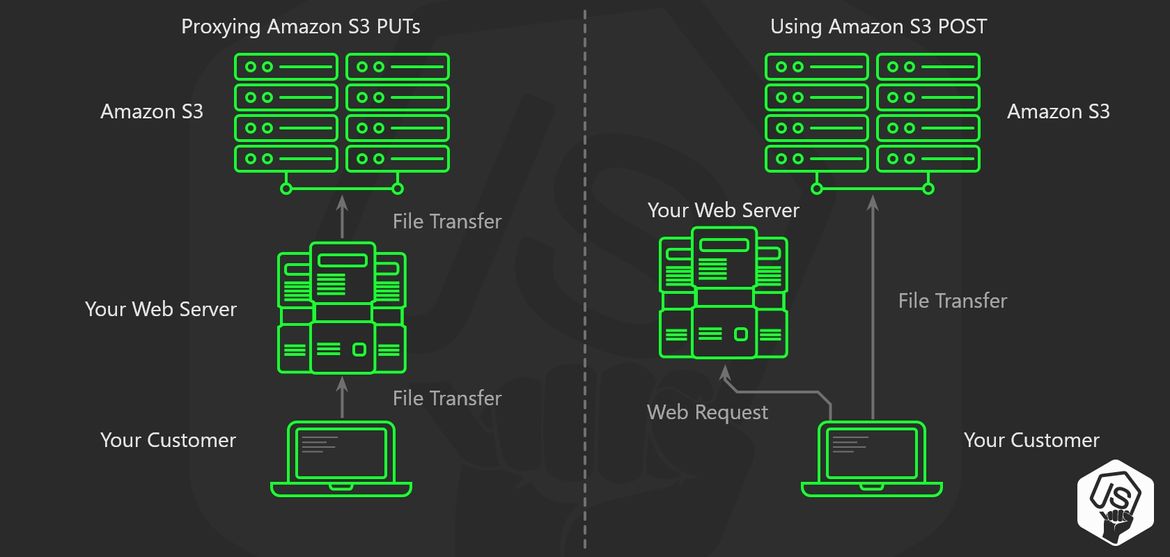
Why you volition desire to upload files to a private S3 directly from the browser?
Well if your application is uploading a file to your server, and and then your server uploads it to an AWS S3 Bucket, you have a clogging and performance trouble.
My clients were uploading big video files, 100mb average, from diverse locations Asia, Europe, and Due north America, my server is hosted on Heroku and located in Northern Virginia just my chief S3 Bucket is in Ireland!
Will be easier and efficient if the web customer has the possibility to upload directly to that AWS S3 Bucket.

Seem'south trivial simply yous may face several problems and the official AWS documentation don't tell y'all much.
The procedure
Yous volition need to generate pre-signed AWS S3 URLs, so a user tin can write an object direct with a POST or PUT call.
Presigned URL (HTTP PUT Method)
A pre-signed URL is a URL that yous generate with your AWS credentials and you provide to your users to grant temporary admission to a specific AWS S3 object.
The presigned URLs are useful if yous want your user/customer to be able to upload a specific object to your bucket, but yous don't require them to accept AWS security credentials or permissions.
When you create a presigned URL, you must provide your security credentials and then specify a saucepan name, an object key, an HTTP method (PUT for uploading objects), and an expiration date and time.
The presigned URLs are valid just for the specified duration.
Culling (HTTP Postal service Form Method)
AWS S3 supports Post, which allows your users to upload content directly to AWS S3.
Mail is designed to simplify uploads, reduce upload latency, and relieve you lot money on applications where users upload data to shop in AWS S3.
Generate Credentials
- Open yous AWS Console and Navigate to IAM

- Create a User with Programmatic access
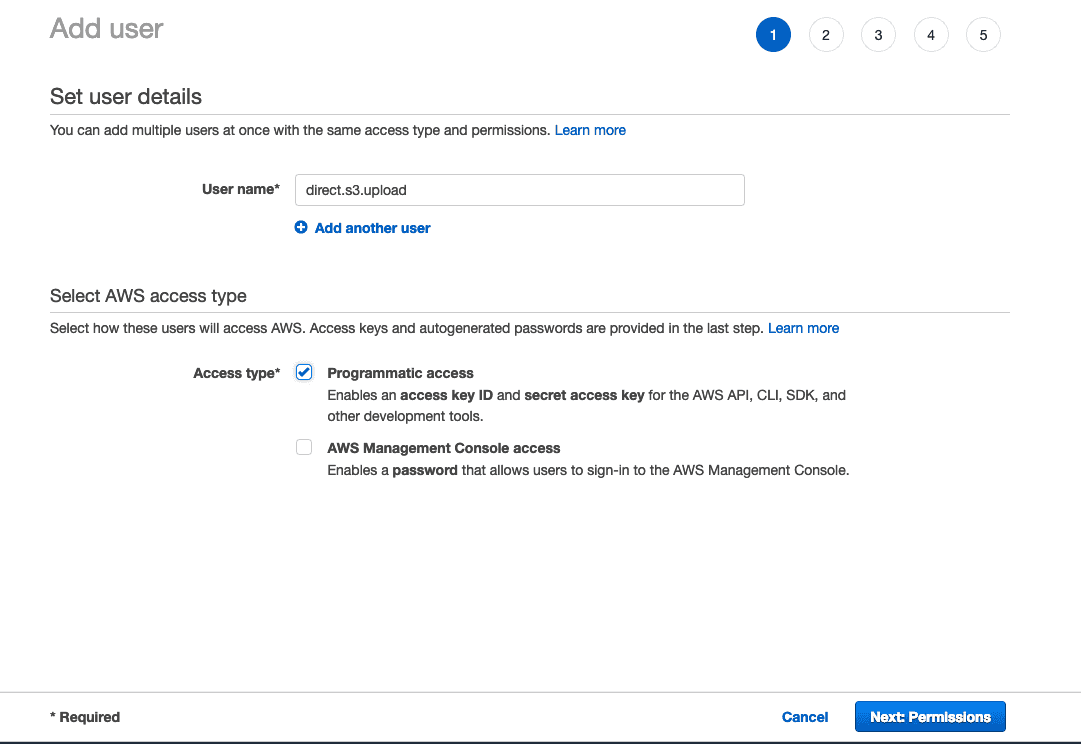
- Click the attach existing policies directly tab

- Click create your ain policy and copy the following
{ "Version" : "2012-10-17" , "Argument" : [ { "Event" : "Permit" , "Action" : [ "s3:Put*" ] , "Resource" : [ "arn:aws:s3:::your-bucket-proper name/*" , ] } ] } 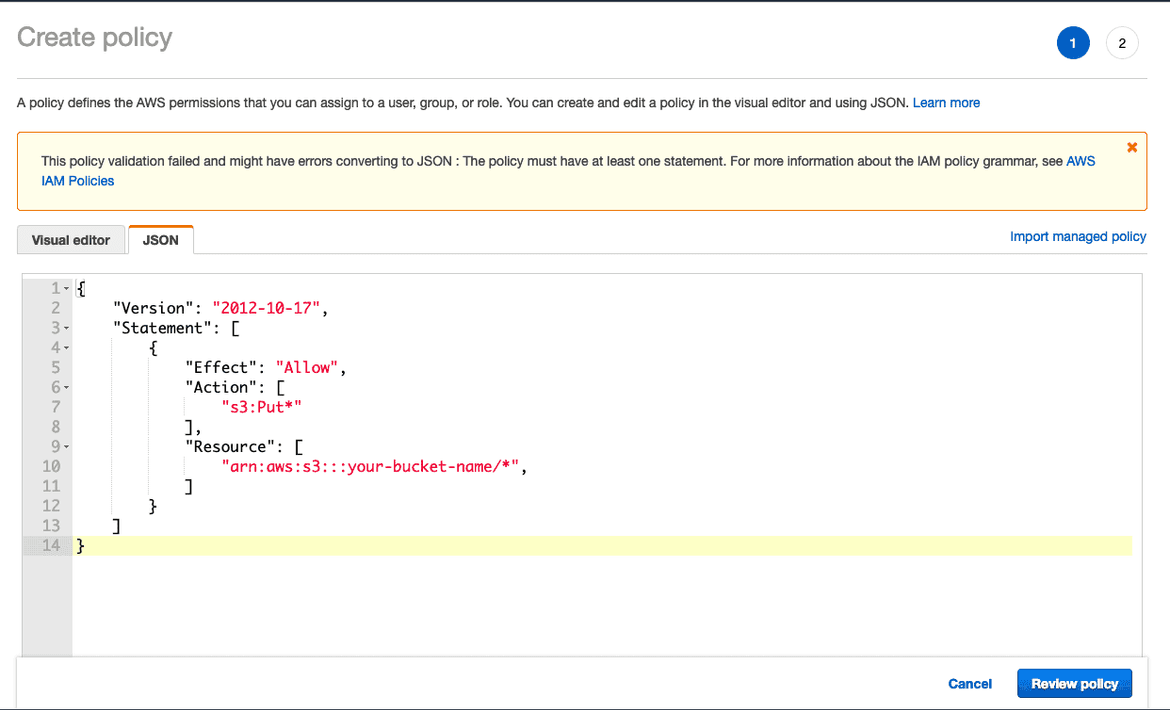
- Click Review Policy and enter a name for the policy.
- Save the policy.
- Add it to your new user.
Configuring S3 CORS policy
The same-origin policy is an of import security concept implemented by web browsers to foreclose Javascript lawmaking from making requests against a different domain than the ane from which it was served.
Cross-Origin Resource Sharing (CORS) is a technique for relaxing the same-origin policy, assuasive Javascript on a web page to making HTTP calls to a different origin.
CORS makes it easier for service providers to distribute content to users while adding interoperability to online services.
- Go to your bucket
- Go to the permissions tab
- Click CORS configuration and copy and paste the following
<?xml version="1.0" encoding="UTF-viii"?> <CORSConfiguration xmlns = "http://s3.amazonaws.com/medico/2006-03-01/" > <CORSRule > <AllowedOrigin > * </AllowedOrigin > <AllowedMethod > HEAD </AllowedMethod > <AllowedMethod > GET </AllowedMethod > <AllowedMethod > PUT </AllowedMethod > <AllowedMethod > Mail </AllowedMethod > <AllowedHeader > * </AllowedHeader > </CORSRule > </CORSConfiguration > CORS makes it easy for web services to speedily and easily integrate without exposing their users.
Activating Transfer Acceleration Endpoint
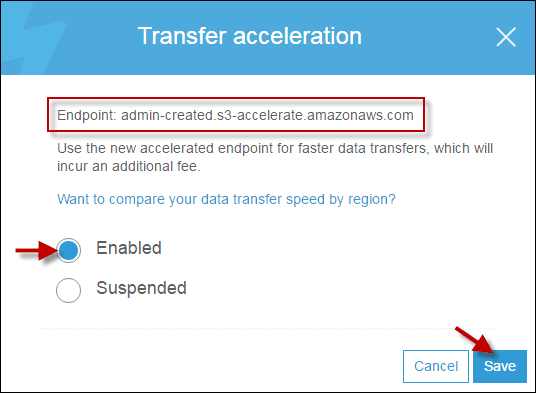
AWS S3 Transfer Dispatch is a bucket-level characteristic that enables faster information transfers to and from AWS S3.
- Go to your saucepan
-
Choose backdrop

- Click on permissions
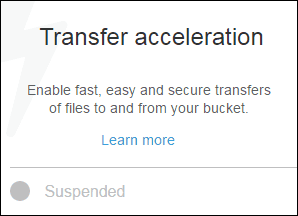
- Scroll to transfer acceleration and agile it
Server Lawmaking - PUT to a transfer acceleration endpoint
You lot accept 2 choices for generating the pre-signed URL, depending on how your client lawmaking will upload the file.
This arroyo generates a PUT endpoint but you can-not use multi-role FormData to upload files. But you can benefit from using AWS Transfer acceleration endpoint Nosotros rely on the getSignedUrl method from AWS-SDK.
Read more about information technology on the AWS S3 SDK
const AWS = require ( 'aws-sdk' ) ; const express = require ( 'express' ) ; const route = express. Router ( ) ; road. become ( '/signed-url-put-object' , async ( req, res ) => { AWS .config. update ( { accessKeyId: 'AAAAAAAAAAAAAAAA' , // Generated on step i secretAccessKey: 'J21//xxxxxxxxxxx' , // Generated on pace one region: 'eu-west-1' , // Must be the same every bit your bucket signatureVersion: 'v4' , } ) ; const params = { Bucket: 'your-bucket-proper noun' , Key: 'my-crawly-object.webm' , Expires: 30 * 60 , // 30 minutes ContentType: 'video/webm' } ; const options = { signatureVersion: 'v4' , region: 'eu-west-1' , // same equally your bucket endpoint: new AWS.Endpoint ( 'your-saucepan-name.s3-advance.amazonaws.com' ) , useAccelerateEndpoint: true , } const client = new AWS.S3 (options) ; const signedURL = await ( new Hope ( ( resolve, turn down ) => { client. getSignedUrl ( 'putObject' , params, ( err, data ) => { if (err) { pass up (err) } else { resolve (data) } } ) ; } ) ) ; return res. json ( { signedURL, } ) } Server Code - POST Multi-Office FormData
Get a pre-signed POST policy to back up uploading to S3 direct from an HTML course from the browser.
With this, yous will generate a Form and you must send all the fields in a FormData object in a Mail request to the AWS S3 bucket.
Yous can not use the transfer acceleration endpoint considering is a CloudFront endpoint that information technology's not configured with the necessary CORS options and y'all cannot change information technology sadly.
Simply this is useful if you lot are developing a react native awarding and you accept the needed of using a FormData or whatever other scenario where y'all must utilise multi-function uploads.
For this method we rely on the createPresignedPost method from AWS-SDK please note the difference with the previous method.
Read more nigh it on the AWS S3 SDK
Yous cannot use transfer acceleration with this method
const AWS = crave ( 'aws-sdk' ) ; const limited = require ( 'limited' ) ; const route = express. Router ( ) ; road. become ( '/signed-form-upload' , async ( req, res ) => { AWS .config. update ( { accessKeyId: 'AAAAAAAAAAAAAAAA' , // Generated on step 1 secretAccessKey: 'J21//xxxxxxxxxxx' , // Generated on step ane region: 'eu-west-1' , // Must be the aforementioned equally your bucket signatureVersion: 'v4' , } ) ; const params = { Bucket: 'your-bucket-name' , Primal: 'my-awesome-object.webm' , Fields: { Fundamental: 'my-awesome-object.webm' , } , } ; const options = { signatureVersion: 'v4' , region: 'eu-westward-1' , // aforementioned as your bucket endpoint = new AWS.Endpoint ( 'https://your-saucepan-name.s3.amazonaws.com' ) , useAccelerateEndpoint = false , s3ForcePathStyle = true , } const client = new AWS.S3 (options) ; const course = look ( new Promise ( ( resolve, reject ) => { client. createPresignedPost (params, ( err, data ) => { if (err) { decline (err) } else { resolve (data) } } ) ; } ) ) ; return res. json ( { form: { ...form, url: config.aws.s3. AWS_S3_ENDPOINT } } ) } Mutual Problems
"SignatureDoesNotMatch"
<?xml version="ane.0" encoding="UTF-8"?> <Error > <Code > SignatureDoesNotMatch </Code > <Message > The request signature we calculated does non match the signature you lot provided. Check your key and signing method. </Bulletin > <StringToSignBytes > 90 81 89 12 ... </StringToSignBytes > <RequestId > G7AAF1689RC5909C </RequestId > <HostId > q+r+2T5K6mMKLKTWw0R9/jm33LyIfZFACY8GEDznfmMrRxvaVJwPiu/hlofuJWbW </HostId > <StringToSign > PUT video/webm 456789067 x-amz-acl:authenticated-read /your-bucket-proper noun/ </StringToSign > <AWSAccessKeyId > youraccesskey </AWSAccessKeyId > </Error > S3 creates a signature past combining file type, the file central, content-blazon, and and then on.
If yous are having this problem check:
- Make sure you are passing the right Content Type Header.
- Check that you are using Mail with the course upload method, or PUT with the transfer acceleration endpoint.
- The file type and file key MUST exactly friction match the i which was provided when the pre-signed URL was created.
- When using POST FormData method, cheque that you are sending all the form fields that were generated past AWS S3 SDK.
Conclusion
There are several ways to upload files to a private AWS S3 bucket directly from browser, and tin can exist challenging and confusing, but with a piddling endeavor, yous will have a huge improvement in your operation.
In my case the performance upgrade was about 200% cheers to the AWS S3 Transfer Acceleration endpoint.

You can effort this crawly functioning estimator tool right here
Resource
- https://www.digitalocean.com/community/questions/signed-put-url-for-nodejs
- https://sanderknape.com/2017/08/using-pre-signed-urls-upload-file-individual-s3-bucket/
- https://docs.aws.amazon.com/AmazonS3/latest/API/sigv4-UsingHTTPPOST.html
- https://docs.aws.amazon.com/AWSJavaScriptSDK/latest/AWS/S3.html
- https://docs.aws.amazon.com/AmazonS3/latest/user-guide/enable-transfer-acceleration.html
- https://aws.amazon.com/blogs/aws/aws-storage-update-amazon-s3-transfer-acceleration-larger-snowballs-in-more than-regions/
Get The Latest Articles In Your Inbox.
Join the other 2000+ savvy node.js developers who become article updates.
You will receive only high-quality articles about Node.js, Cloud Computing and Javascript front-end frameworks.
Unsubscribe anytime.
Source: https://softwareontheroad.com/aws-s3-secure-direct-upload/

Post a Comment for "upload large files to s3 from javascript"